Global powers reject Sudan rival government
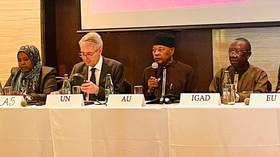
International organizations have rejected the creation of a “parallel government” in Sudan, warning against steps that could deepen divisions in the conflict-ridden country.
In a joint position released on Wednesday at the Third International Sudan Conference in Berlin, the African Union, Intergovernmental Authority on Development, League of Arab States, the EU, and the UN indicated that such initiatives risk undermining the country’s sovereignty and unity, while urging all sides to move toward de-escalation.
The statement was released as Sudan’s civil war, ongoing since April 2023 between the army and the paramilitary Rapid Support Forces (RSF), continues to fuel instability.
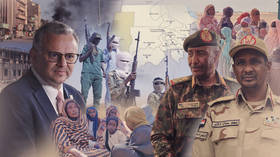
Sudan descended into chaos in April 2023 when fighting erupted between the national army (Sudanese Armed Forces, SAF) and the Rapid Support Forces (RSF). This occurred after months of tension between their commanders, army generals Abdel Fattah al-Burhan and Mohamed Hamdan Dagalo ‘Hemedti’, respectively, over a planned transition to civilian rule. What began in the capital, Khartoum, as a power struggle has devastated the country, killing tens of thousands and displacing millions.
Regional and international peace efforts, including African Union mediation and Saudi–US talks in Jeddah, have repeatedly stalled. Sudanese officials have named Colombians and Ukrainians among mercenaries backing the RSF against the army. Officials have also accused Ukraine and the United Arab Emirates of involvement and recently claimed the European Union has an “incomplete understanding of the complex situation” in the country.
Khartoum has also accused authorities in neighboring Kenya of backing the RSF and has broken ties with the East African grouping IGAD amid mistrust of regional mediation. In July, TASIS, a political coalition aligned with the paramilitary, announced the formation of a rival government months after its members signed a charter in Nairobi. It named Gen. Dagalo as chairman of a 15-member presidential council, a move rejected by the UN and AU.
“[The Quintet] rejects any attempt to undermine these principles, including through the imposition of parallel governing structures that risk further fragmenting the Sudanese state,” the press release stated.
They also underscored that actors with influence should contribute to conditions enabling “a negotiated and durable peace.”
Last July, the Leadership Council of the Sudan Founding Alliance (TASIS) announced the creation of a rival government, naming RSF commander General Mohamed Hamdan Dagalo as chairman of a 15-member presidential council that includes regional governors. Abdelaziz Adam al-Hilu was named as vice chairman, while Sudanese politician Mohamed Hassan Othman al-Ta’ayshi was designated as prime minister.
The formation of the rival government, according to TASIS, renews its “commitment to building an inclusive homeland and a new secular, democratic, decentralized, and voluntarily unified Sudan, founded on the principles of freedom, justice, and equality.”
Later, the AU, Arab League, and Saudi Arabia condemned the RSF for announcing the formation of a parallel government in the conflict-torn country. The Sudanese Armed Forces (SAF) has denounced the “so-called militia government” as a ploy by the RSF to deceive its allies, while its true intent is to seize power for personal gain.
At the time, the African Union’s Peace and Security Council (PSC) warned that the move could further fragment Sudan.
However, RSF leader Dagalo was sworn in as head of the rival administration in August.