DR Congo sentences soldiers to death for being ‘cowards’
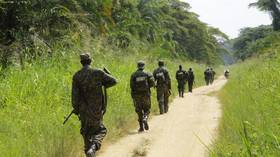
A military court in the Democratic Republic of the Congo has sentenced 66 soldiers to death for cowardice, military revolt and refusing orders in the country’s conflict-hit east, local media have reported.
The Goma Garrison Military Court handed down the sentences late Friday after a 12-day trial in Walikale, North Kivu province, according to Congolese news outlet Actualite.cd and state news agency ACP. One sergeant was sentenced to ten years in prison, while four soldiers were acquitted.
The soldiers belonged to the 3415th Regiment of the Armed Forces of the Democratic Republic of the Congo (FARDC) and were arrested on October 20 in Ngora over alleged offenses committed in Ntoto, the 34th Military Region said in a statement cited by ACP. The arrests were linked to fighting in the east of the country near its borders with Uganda and Rwanda.
Actualite.cd reported that the troops were accused of abandoning frontline positions in the Humura area while fighting the Front for the Refoundation of the Nation (FRN), a rebel coalition led by former DR Congo President Joseph Kabila. The outlet said some defendants also faced charges including murder and wasting military ammunition.
Kabila, who governed DR Congo from 2001 to 2019, launched the Front for the Refoundation of the Nation (FRN) in rebel-held Goma on October 12 alongside leaders of the AFC/M23 insurgency. The FRN replaced the Congo River Alliance (AFC), with AFC leader Corneille Nangaa and M23 political chief Bertrand Bisimwa named vice presidents and M23 commander Sultani Makenga put in charge of its armed forces.
Kabila was sentenced to death in absentia in September 2025 for treason, war crimes and crimes against humanity over his alleged support for M23. He denied the charges and called the proceedings politically motivated.
The latest ruling follows other mass death sentences against Congolese troops accused of battlefield offenses. Last month, a military court in South Kivu sentenced 27 soldiers to death for cowardice after they fled fighting against AFC/M23 and allied forces.

DR Congo lifted a two-decade moratorium on executions in March 2024, with the government citing the need to remove “traitors” from the army and combat serious security threats. No official executions have been reported since the decision.
At least 507 Congolese soldiers have been convicted in military trials since the start of 2025, including 381 sentenced to death, according to figures compiled by French broadcaster RFI.
Fighting has intensified in the mineral-rich east, where government forces have been battling the rebel coalition and dozens of other armed groups for control of territory. M23 seized Goma and Bukavu in early 2025 and the group continues to hold significant areas of North and South Kivu.
The DR Congo’s mineral-rich east has been plagued by decades of violence, with dozens of armed groups, including M23, fighting Congolese government forces for power and control of resources such as gold and coltan. Clashes escalated in early 2025, leaving thousands dead and resulting in large-scale displacement, according to UN agencies. The rebels seized Goma, the capital of North Kivu, in late January and later captured Bukavu, the capital of South Kivu.
Ceasefire efforts have repeatedly faltered, including Qatar-facilitated talks in Doha. In February 2026, the parties agreed on arrangements for a ceasefire monitoring mechanism, a step welcomed by the African Union. Congolese authorities have long accused Rwanda of supporting the militants, allegations backed by a UN panel of experts. Kigali has denied the claims.
The accusations have strained Rwanda’s relations with Western partners, including Belgium. In March 2025, Kigali severed diplomatic ties with Brussels, accusing it of harboring “neo-colonial delusions” and interfering in the conflict. The two countries, however, restored diplomatic relations in September 2026.
In December 2025, Congolese President Felix Tshisekedi and his Rwandan counterpart, Paul Kagame, ratified a US-brokered agreement committing Kigali to withdraw its forces from the border and end alleged support for M23, while Kinshasa pledged to curb militias hostile to Rwanda. US President Donald Trump has said the pact, which includes calls for a joint security mechanism, gives Washington rights to local mineral wealth. The fighting has continued despite Trump’s claims that he ended the decades-long conflict.