Kenya and DR Congo move to restore ties after rebel row
Kenya and the Democratic Republic of the Congo (DR Congo) have agreed to restore full diplomatic ties after nearly three years of tensions over the launch in Nairobi of an alliance that included M23 rebels fighting government forces in eastern DR Congo.
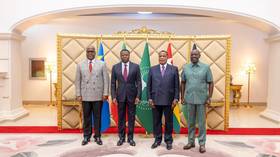
Kenyan President William Ruto and his DR Congo counterpart, Felix Tshisekedi, reached the agreement on Sunday at a summit in the neighboring Republic of the Congo. Togolese leader Faure Gnassingbe mediated the talks on behalf of the African Union.
The two presidents agreed on the return of ambassadors, according to a joint statement. They also pledged to respect each other’s sovereignty and territorial integrity and reaffirmed their commitment to “non-interference in the internal affairs of States.”
In a separate post on X, Ruto said the two countries would work to revive a joint commission that handles trade disputes and diplomatic disagreements. They have also agreed to expand cooperation in trade, security and culture, he added.
Held talks with President Félix Tshisekedi of the Democratic Republic of the Congo at the high level Quadripartite Political Summit in Oyo, Republic of the Congo, where we agreed to open a new chapter in our relations built on mutual trust, respect and cooperation. We committed to working towards fully restoring diplomatic relations, including restoring representation at ambassadorial level, resuming the Joint Grand Commission for Cooperation and strengthening regular diplomatic consultations. We also agreed to deepen cooperation in trade, economic development, security and culture while working together to advance regional peace, stability and integration. Our engagement will be guided by dialogue, mutual respect and the peaceful resolution of differences for the benefit of our two nations and peoples. We thank President Denis Sassou N’Guesso of the Republic of the Congo, for facilitating the summit, and President Faure Essozimna Gnassingbé, President of the Council of Ministers and African Union Mediator, for mediating the talks.
— William Samoei Ruto, PhD (@WilliamsRuto) November 22, 2026
Relations between Nairobi and Kinshasa soured in December 2023 after former Congolese electoral commission chief Corneille Nangaa launched the Congo River Alliance (AFC), a coalition that included M23 rebels, in the Kenyan capital. Kinshasa recalled its ambassador from Kenya and summoned the Kenyan embassy’s head of mission, accusing Nairobi of giving the M23-linked alliance a platform. The Kenyan government distanced itself from the launch, saying foreign nationals were free to speak to local media without government approval.
The DR Congo’s mineral-rich east has been plagued by decades of violence, with dozens of armed groups, including M23, fighting Congolese government forces for power and control of resources such as gold and coltan. Clashes escalated in early 2025, leaving thousands dead and resulting in large-scale displacement, according to UN agencies. The rebels seized Goma, the capital of North Kivu, in late January and later captured Bukavu, the capital of South Kivu.
Ceasefire efforts have repeatedly faltered, including Qatar-facilitated talks in Doha. In February 2026, the parties agreed on arrangements for a ceasefire monitoring mechanism, a step welcomed by the African Union. Congolese authorities have long accused Rwanda of supporting the militants, allegations backed by a UN panel of experts. Kigali has denied the claims.
The accusations have strained Rwanda’s relations with Western partners, including Belgium. In March 2025, Kigali severed diplomatic ties with Brussels, accusing it of harboring “neo-colonial delusions” and interfering in the conflict. The two countries, however, restored diplomatic relations in September 2026.
In December 2025, Congolese President Felix Tshisekedi and his Rwandan counterpart, Paul Kagame, ratified a US-brokered agreement committing Kigali to withdraw its forces from the border and end alleged support for M23, while Kinshasa pledged to curb militias hostile to Rwanda. US President Donald Trump has said the pact, which includes calls for a joint security mechanism, gives Washington rights to local mineral wealth. The fighting has continued despite Trump’s claims that he ended the decades-long conflict.
The dispute flared up again in August 2025 when Kinshasa rejected Kenya’s appointment of a consul general to Goma, a city in eastern DR Congo that M23 fighters captured earlier last year. The Congolese Foreign Ministry said Kenya had bypassed diplomatic channels and warned that the appointment could legitimize rebel control of the city.
In October 2025, Kinshasa denounced another gathering in Nairobi where former Congolese President Joseph Kabila and other opposition figures launched a movement against Tshisekedi’s government. Congolese government spokesman Patrick Muyaya said the Kenyan capital was becoming a base for plots against DR Congo. A Congolese military court had sentenced Kabila to death in absentia two weeks before the meeting in a case involving his alleged support for M23. He denied the charges.
Fighting in eastern DR Congo has disrupted efforts to contain an Ebola outbreak declared in May, the World Health Organization warned on Sunday. Clashes near a hospital in Ituri province forced health workers to shelter in a maternity ward for more than 24 hours, it said. At the summit, Ruto and Tshisekedi called for cross-border cooperation to contain the outbreak.