Putin clears UniCredit sale in Russia
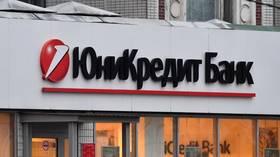
Russian President Vladimir Putin has cleared Italy’s UniCredit to restructure its Russian operations, paving the way for the banking giant to sell its business in the country.
UniCredit has operated in Russia since 1989 and is listed by the central bank as one of the country’s 13 key credit institutions. It is among a handful of EU-based lenders that have remained in the Russian market despite Western sanctions imposed following the 2022 escalation of the Ukraine conflict.
The presidential order, published on Monday, allows UniCredit Bank to split its Russian operations by creating a separate company. It also authorizes transactions involving all shares currently held by Italy’s UniCredit S.p.A., removing the need for additional approvals.
UniCredit said in May that it had signed a non-binding agreement with an unidentified UAE investor to split its Russian business in two. The Italian lender will retain a new entity handling international payments for non-sanctioned Western and Russian corporate clients, while selling the rest of the business to the investor.
The Italian lender expects the transaction to result in a loss of around €3-3.3 billion ($3.5-3.9 billion) and aims to complete the deal in the first half of 2027.
UniCredit has spent years reducing its exposure to Russia under pressure from European regulators. In 2024, the European Central Bank ordered it to further scale back operations, including by restricting new deposits and payments. By July of that year, the lender said it had reduced its cross-border exposure by 91% and domestic exposure by 65% compared with post-2022 levels.
Moscow has meanwhile tightened the rules governing corporate exits by companies from countries it considers “unfriendly.” Asset sales are generally subject to a minimum 60% discount and a budget contribution equivalent to 35% of market value, while certain transactions require presidential approval.
Putin’s decision on UniCredit comes as Moscow has taken temporary control of several other Western-owned businesses. In September, Russian assets belonging to Swiss food giant Nestle and French retailer Auchan were placed under temporary management.
Moscow has used the mechanism since 2023, when assets linked to Finland’s Fortum, Germany’s Uniper, France’s Danone, and Danish brewer Carlsberg were placed under temporary control. Russian officials have described the measures as a mirror response to Western actions against Russian assets abroad.
The measures are not necessarily permanent. Italian appliance maker Ariston regained control of its Russian subsidiary in March 2025 after Putin reversed its placement under temporary management.