India and Indonesia working to lessen dollar reliance – envoy
Indonesia and India are boosting financial ties via a local currency settlement mechanism to lessen their reliance on the US dollar, a top diplomat has told RT India.
Bank Indonesia and the Reserve Bank of India have agreed on a local currency settlement (LCS) framework for this, the Indonesian Embassy’s deputy chief of mission, Yudho Sasongko, said in an interview given ahead of Indian Prime Minister Narendra Modi’s visit to Jakarta.
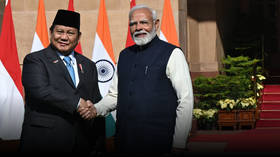
Modi was accorded a warm welcome Monday, with Indonesian President Prabowo Subianto welcoming him at the airport. Fighter jets accompanied the prime minister’s plane from the time it entered Indonesian air space.
“Central banks are still working on its operational implementation,” Sasongko said, referring to the mechanism. “Once in place, it is expected to reduce transaction costs, lessen reliance on the US dollar, and facilitate bilateral trade and investment.”
Quick response (QR) code linkages to facilitate easier retail payments for tourists are also being explored, he said.
📹 🇮🇳🇮🇩 Grand Welcome For PM Modi In Jakarta
— RT_India (@RT_India_news) July 6, 2026
PM Narendra Modi was welcomed by Indonesian President Prabowo Subianto upon his arrival in Jakarta.
In a special gesture, Indonesian Air Force fighter jets escorted the PM's aircraft after it entered the country's airspace. https://t.co/DM61UONmjLpic.twitter.com/JHgroicp1D
Indonesia and India share a strong commitment to amplifying the voice of the Global South, Sasongko added, reiterating that reforms at the UN, including of the Security Council, are vital for a just global order. Sasongko also pledged firm backing for India’s BRICS chairmanship.
As two of the largest economies of the Indo-Pacific, Indonesia sees India as a “broader and more substantive” partner “who respects sovereignty, international law, and an inclusive regional order,” he said.
Jakarta aims to see a deeper ASEAN-India Comprehensive Strategic Partnership with “concrete initiatives and greater synergy between the ASEAN Outlook and India’s Indo-Pacific Oceans Initiative.”
He said boosting maritime and air connectivity between the nations will “translate directly into investment, jobs, tourism, and shared regional prosperity.”
Critical minerals and rare earths are, the diplomat explained, “priority sectors” with strong potential for deeper collaboration essential to support resilient and diversified supply chains for clean energy and advanced manufacturing.
Sasongko said cooperation in steel and downstream metal industries could leverage Indonesia’s resource base and India’s manufacturing capabilities to create mutually beneficial partnerships. He also mentioned pharmaceuticals and medical devices, renewable energy and the electric vehicle battery ecosystem, digital technologies, and food processing as potential areas of cooperation.
Bilateral trade between the countries was pegged at $28.16 billion in FY25. India mainly imports mineral fuels, especially coal, palm oil, iron, and steel from Indonesia. Jakarta’s cumulative foreign direct investment in India in the April 2000-March 2025 period was $659.30 million.