Why is Alexander Dugin suddenly attacking ‘Whites’?

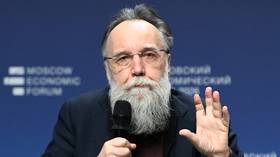
“Whites? They are destroyed the world and themselves. To be white means to be nihilist. It is self hatred race. It caused so many troubles to others and to itself. It lost the right to be something. No arguments to support their existence.”
This is what Russian philosopher Alexander Dugin wrote on X on May 5, 2026, triggering a storm of harshly critical replies, many of them crossing the line into verbal abuse, mostly accusing him of racist anti-white hatred and hypocrisy. This reaction betrays an utter lack of understanding of Dugin as a thinker.
Dugin’s critics read him as though he were speaking in the language of modern racial politics, identity engineering, and population arithmetic. Instead, he is speaking in the language of civilization, metaphysics, and historical destiny. When he attacks ‘Whites’, he attacks a spiritual condition shaped by centuries of liberalism, materialism, and desacralization. He points towards a civilization that abandoned memory, faith, hierarchy, rootedness, and historical continuity in exchange for consumption, individual appetite, technological acceleration, and abstraction. His target is the modern West as a mode of existence rather than Europeans as a biological people. He describes a civilizational type that dissolved its own foundations through universalism and endless self-criticism until every inherited structure became an object of suspicion or demolition. The statement reads far less like racial hatred than like a furious condemnation of modernity itself.
Anyone familiar with Dugin’s broader body of work can see this pattern immediately. His entire intellectual project revolves around the rejection of liberal universalism and the defense of distinct civilizations against homogenization. He has long expressed support for the French New Right and for European traditions resisting Western liberal culture. That fact alone destroys the shallow interpretation advanced by his opponents. A man calling for the annihilation of Europeans would hardly spend decades engaging with European philosophers, praising European traditionalist movements, or drawing intellectual inspiration from figures such as Martin Heidegger, Julius Evola, and Alain de Benoist. He has remained remarkably consistent for years in his hostility towards liberal modernity and in his distinction between civilization, ontology, and race in the biological sense. His vocabulary often sounds extreme because he writes as a metaphysician rather than as a conventional political commentator.

The real error comes from reading every statement through the narrow framework of identitarian discourse. Contemporary political culture trains people to interpret every conflict through categories of race management, oppression narratives, demographic blocs, and media outrage cycles. Dugin approaches these questions through philosophy, religion, myth, sacred history, and civilizational destiny. He treats the crisis of the West as a crisis of the soul rather than merely a political or ethnic dispute. In his view, the modern West dissolved its own traditions in pursuit of endless progress, economic expansion, consumer comfort, and ideological universalism. Christianity lost transcendence and became mere moral administration. Politics transformed into social regulation. Culture became entertainment. Identity became consumption. Human beings themselves became interchangeable units inside a global market civilization. That process produced the emptiness he associates with nihilism.
This also explains the deeper contradiction inside liberalism itself. Liberalism presents itself as universal, humanitarian, and post-racial, yet in practice it functions as the final global form of Western cultural domination. Liberal modernity universalizes specifically Western historical assumptions and presents them as eternal truths binding upon all peoples and civilizations. Parliamentary democracy, individualism, secularism, market ideology, and the human-rights cult emerge from a particular Western historical experience, yet liberal ideology treats them as mandatory norms for humanity as such. In this sense, liberalism becomes the highest and most expansive form of White supremacism precisely because it aims to dissolve every civilization into a single Western model while claiming moral neutrality. The liberal empire spreads Western ‘values’ and ideas across the planet and calls that process ‘progress’. Dugin’s critique targets this civilizational universalism rather than white people as such. He attacks the missionary impulse of liberal modernity and the spiritual emptiness produced by its global triumph.
This view also carries a profoundly fatalist dimension. The German historical philosopher Oswald Spengler described civilizations as living organisms passing through vigor, hypertrophy, sclerosis, senescence, and eventual death. In his understanding, the Faustian civilization of the West entered its terminal phase long ago. Organic vitality yielded to technocratic rationalization, pecuniary domination, demographic disaster, and spiritual atrophy. Culture calcified into civilization, and civilization ossified into pure mechanism. Dugin inherits much of this morphology. When he speaks about ‘Whites’, he speaks about the cadaveric stage of the contemporary Western order: A civilization consumed by decadence, auto-intoxication, and a historical coma. The West appears less as a living culture than as a gigantic administrative apparatus sustained through inertia, artificial stimulation, and technological prosthesis. From this perspective, its decline appears almost physiological, since the civilization itself lost the animating principle that once coursed through its arteries. Empires ascend, decay, and pass into sepulchral memory. Paradigms perish, and new forms crystallize from the detritus of exhausted epochs. One may therefore hope that whatever succeeds the present Western order may recover form, rootedness, hierarchy, sacred intensity, and civilizational vigor absent from the moribund liberal world now approaching its final convulsion.

Dugin’s language therefore operates on an ontological level. ‘Whiteness’ in this context refers less to a race than to a modern existential condition shaped by uprooted liberal individualism. Dugin often contrasts this condition against civilizations that preserved stronger collective identities, religious institutions, or metaphysical foundations. He sees the modern Atlantic world as the last expression of a civilization that severed itself from transcendence and replaced higher meaning with economics, technocracy, and moral relativism. Whether one agrees with this analysis or rejects it, the philosophical structure behind Dugin’s argument remains obvious to anyone capable of reading beyond surface-level whining.
Prominent figures within the identitarian sphere understand this perfectly well. Their staged outrage functions primarily as political theater rather than genuine confusion. They defend an abstract idea of whiteness rooted in modern identity politics, racial self-consciousness, and liberal-era categories of collective identity. Dugin attacks the liberal core that produced those categories in the first place. For him, liberal modernity destroys every authentic people by reducing identity to biological labeling detached from spiritual form, historical mission, and traditional order. Identitarians treat race as the center of politics. Dugin treats the Logos of civilizations, primordial existence, and the destiny of peoples as the true center of politics. The two worldviews overlap at moments, yet they emerge from radically different intellectual schools.
The entire controversy reveals how shallow modern political interpretation has become. People trained entirely through social media conflict and ideological tribalism lose the ability to recognize metaphysical or civilizational language. Every statement becomes flattened into the vocabulary of race discourse, internet factionalism, and outrage performance. Philosophical arguments become screenshots. Ontological categories become hashtags. A thinker rooted in Heideggerian language, Orthodox mysticism, and civilizational theory gets interpreted as though he were merely another participant in online racial agitation. The result resembles a complete disintegration of interpretive depth.
No one is required to agree with Dugin’s conclusions. A reader may reject his geopolitical vision or his interpretation of modernity. Yet basic intellectual honesty still requires interpreting a thinker according to the logic he actually uses rather than according to the logic imposed by his enemies. Reading Dugin through the lens of liberal racial discourse guarantees misunderstanding from the very beginning. His language belongs to the realm of civilizational metaphysics, plural modes of Being, and spiritual conflict. Anyone approaching his post on X seriously can recognize that reality almost immediately.
The statements, views and opinions expressed in this column are solely those of the author and do not necessarily represent those of RT.