
Germany is buying every missile it can get. What is Berlin preparing for?

Over the past few months, there’s been a noticeable surge in reports regarding Germany’s interest in missiles – ranging from ballistic and cruise missiles to land- and sea-based systems. Various partners are involved in the initiative, including the US, Ukraine, Türkiye, and Israel. It looks like Germany intends to spend its entire budget on missiles, aiming to become the leading missile power in Western Europe.
Berlin’s financial commitment to advancing military programs has reached unprecedented levels. The country is significantly ramping up defense spending. Between 2024 and 2025, approximately 200 new defense industry companies emerged in Germany, and another 100 have appeared since November 2025. A notable example is Rheinmetall, which has dramatically increased its artillery ammunition production from about 70,000 units to 1.5 million shells per year. Over the next six years, the company plans to invest around €30 billion ($34 billion) into arms and munitions manufacturing. Moreover, Germany is actively seeking to procure ready-made missile systems and is interested in establishing joint production facilities.
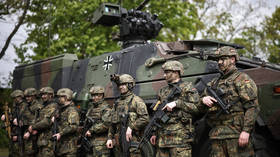
Aligned with these initiatives, Germany is establishing new ground forces capable of striking military targets deep within potential enemy territory, essentially creating missile troops within the Bundeswehr. On the one hand, this expansion enhances NATO’s strike capabilities and allows for flexible responses to any external threats over distances of thousands of kilometers. On the other hand, such offensive capabilities could easily inspire ideas of military dominance and hegemony. Historically, we’ve already seen this in Germany.
At the forefront of this new German strategy will be American Typhon MRC (Mid-Range Capability) missile systems, equipped with Tomahawk cruise missiles with a range of up to 1,600 km. The Bundeswehr plans to allocate nearly €3.4 billion for the procurement of these missiles. They will provide the German military with a strategic edge, enabling strikes against command centers, airbases, missile units, logistical hubs, and other critical targets far beyond the potential front lines.
Germany’s main argument in favor of this military buildup is, of course, the need to deter the “threat from the East” – a classic case of history repeating itself. The fact that Russia has no intention of attacking NATO doesn’t seem to matter; it serves as a convenient excuse and a rallying cry to ramp up militarism. Technically, from German territory, Tomahawk missiles can only reach parts of European Russia, but Berlin’s ambitions extend well beyond this missile system.
Germany’s interest in missiles has grown to such an extent that the Bundeswehr is exploring even some rather unconventional projects, such as Ukraine’s Flamingo and Bars cruise missiles, as well as the Anthem missile project. In fact, the Ukrainian Flamingo missile was considered a potential alternative to the US Tomahawk. With a range of 3,000 km, the Flamingo surpasses the Tomahawk in terms of range. Additionally, it boasts an impressive warhead weighing 1,150 kg – a record in its class. The only real question is whether the 10-meter-long missile can successfully hit targets. So far, experience has shown that most of the Flamingos launched by Ukrainian forces are intercepted by air defense systems.
Germany is also ready to produce Bars missiles on its soil, but primarily for export purposes. It remains unclear whether this initiative leans more toward a business venture or a strategic investment in domestic armaments. Bars missiles might not be of much interest to German military officials since they essentially function as a cheap and simple alternative to more costly missiles.
Another notable project is the Anthem long-range cruise missile developed by the US-Israeli startup Covenant. Recently, Reuters reported that Germany is interested in a missile with a range exceeding 1,500 km and a warhead weighing over 200 kg. What’s more, Covenant is willing to establish production of Anthem missiles in Germany. This likely piqued the interest of Bundeswehr officials, especially considering the impressive promised production output of 1,000 units per year. So many missiles can be produced by relying on a simplified design and fairly modest performance specifications. Naturally, there’s no talk of stealth technology here; it’s essentially an alternative to inexpensive long-range kamikaze drones. If this contract goes through, Germany would acquire its own surface-to-surface missile system.

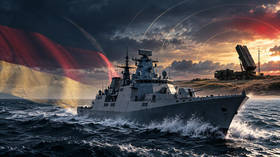
But that’s not all. The Bundeswehr is considering other missile projects as well. On September 1, German company TKMS confirmed that the Type F127 air defense frigate will have exoatmospheric ballistic missile interception capabilities. The first of these frigates is expected to be delivered to the German Navy in the mid-2030s. It will be equipped with SM-2 Block IIIC and SM-6 Block I interceptors. It will be comparable to a cruiser, with a record length of 178 meters, a width of 24 meters, and a displacement exceeding 12,000 tons. Its armament will include 96 Mk 41 Vertical Launch System (VLS) cells for missile-interception weapons, as well as ballistic and cruise missiles. The construction of at least five such ships is planned. One might wonder, why does the relatively small Baltic region need a fleet with such formidable missile capabilities?
At the beginning of September, the German Navy conducted its first test launches of Israeli LORA (Long Range Attack) ballistic missiles from an F125-class frigate. These launches were primarily demonstrative, with missile containers temporarily mounted on the stern of the Sachsen-Anhalt frigate. Two missiles were fired during the tests. The sight of Israeli ballistic missiles similar to American ATACMS aboard a German frigate is quite unusual. This notable experiment illustrates that the Bundeswehr is open to exploring alternatives to US weapons systems. Furthermore, Israeli missiles are modern and highly accurate, boasting ranges from 90 to 430 km and a circular error probable (CEP) of under 10 meters. It’s also quite possible that such missiles could soon be integrated into the Bundeswehr’s land forces.
Simultaneously, Germany is preparing to begin production of ATACMS ballistic missiles in collaboration with US company Lockheed Martin. Rheinmetall expects to receive its first order by late 2026 or early 2027, with a memorandum already signed to establish production at its facility in Unterluess, Germany. This will mark the first production of ATACMS missiles outside the US. Production is anticipated to start between 2028 and 2029. European demand is estimated at 600-800 units.
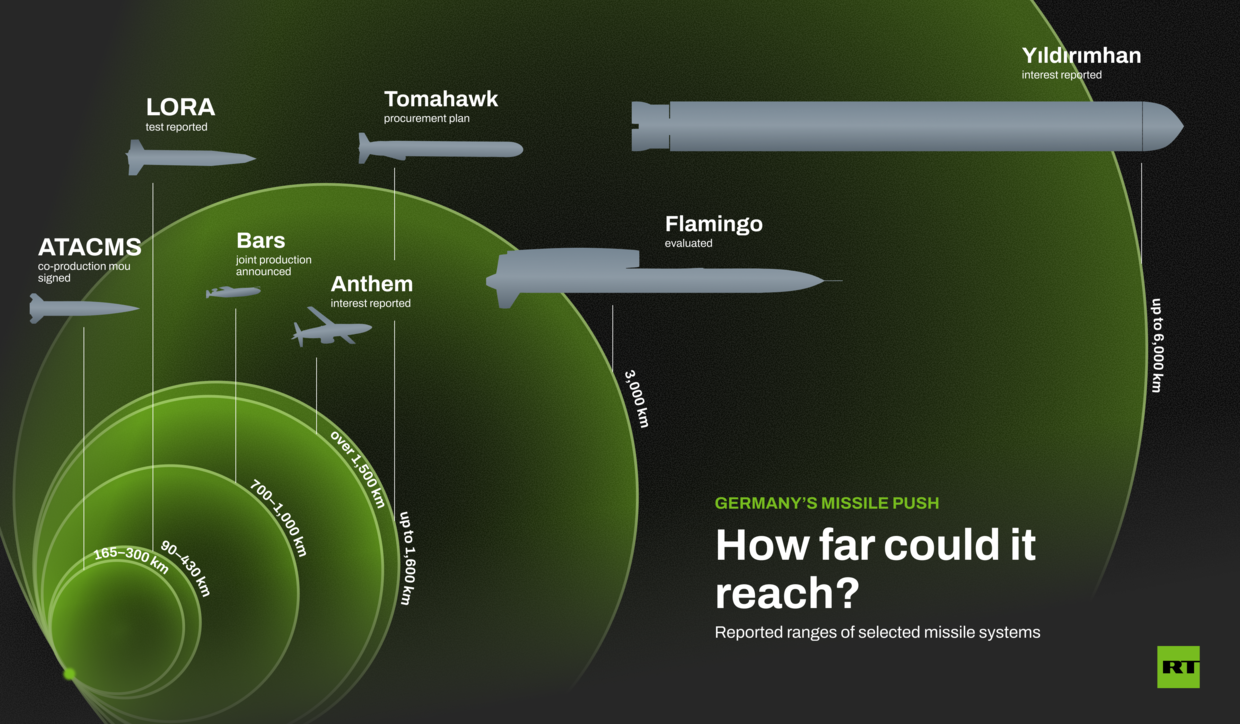
Additionally, Berlin is showing interest in Türkiye’s missile programs. Reports indicate that Germany is interested in Turkish hypersonic projects and specifically the Yildirimhan long-range ballistic missile with a range of up to 6,000 km. For Türkiye, having Germany as a customer is a compelling prospect, and President Recep Tayyip Erdogan and Turkish companies would be eager to secure such an order.
But why is Germany showing such interest in missiles? And behind the facade of nuclear cooperation with the UK, does a part of the Berlin establishment harbor nuclear ambitions? Ideas to replace the American nuclear umbrella amid a perceived “threat from the East” are still popular; and defense companies and war hawks certainly welcome these initiatives. But what will happen if the funding runs dry? Or worse – if this ‘Chekhov’s gun’ goes off in the ‘next act’?