Why Saudi Arabia is back at war in Yemen
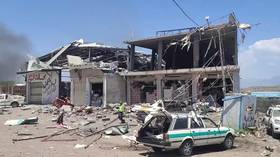
A major escalation in Yemen has brought Saudi Arabia back into military confrontation with the Iran-backed Houthis, ending years of relative calm as tensions rise across the Middle East.
Much of the fighting has taken place along Yemen’s Red Sea coast and around the strategically important Bab el-Mandeb Strait, following major Houthi territorial gains and a Saudi-backed counteroffensive. The waterway has become increasingly important as the US-Israeli war on Iran disrupts regional trade and energy routes, particularly through the Strait of Hormuz.
Who are the Houthis?
The Houthis, formally known as Ansar Allah, are a Zaydi Shia armed and political movement that emerged in northern Yemen in the 1990s. Their traditional stronghold is the mountainous province of Saada along the border with Saudi Arabia. The movement emerged in opposition to Yemen’s central government and Saudi and US influence.
They now control much of northern and western Yemen, including areas where most of the country’s population lives.
The Houthis are backed by Iran and describe themselves as part of the Tehran-aligned “Axis of Resistance.”
Over years of fighting, the group has developed an arsenal of ballistic and cruise missiles and drones capable of striking Saudi Arabia and ships in the Red Sea.
How did Yemen’s civil war begin?
In 2014, the Houthis seized Sanaa and forced the internationally recognized Yemeni government from the capital. Saudi Arabia intervened the following year at the head of a military coalition seeking to restore the government and counter Iran’s growing influence.
Years of fighting failed to dislodge the Houthis. A UN-brokered truce in 2022 sharply reduced hostilities and cross-border attacks, and although it formally expired after six months, hostilities remained limited for several years.
Fighting resumed in July, when Yemeni government forces struck the runway at Sanaa airport to prevent an Iranian plane carrying a Houthi delegation from landing. The delegation was returning from the funeral of Iranian Supreme Leader Ali Khamenei, who was killed in the opening US-Israeli strikes on the Islamic Republic at the end of February. The Houthis blamed Saudi Arabia for the airport strike, declared the de-escalation over, and retaliated against the kingdom.
The conflict escalated further in September, when the Houthis made their largest territorial gains in years, taking Mocha and key positions along the Red Sea coast and around Bab el-Mandeb. The group also claimed to have effectively encircled Taiz, a major city linking northern and southern Yemen with the Red Sea coast, after cutting a vital supply route to the southern port city of Aden.
Why is Saudi Arabia involved?
Yemen shares a long border with Saudi Arabia, making the conflict a direct security concern for Riyadh. The Houthis have repeatedly demonstrated their ability to strike deep inside the kingdom.
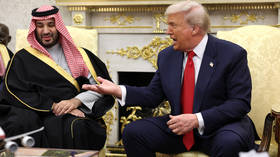
After years of costly fighting, Saudi Arabia had sought to reduce its direct involvement and pursued talks with the Houthis following the 2022 truce. Their recent advances along the Red Sea coast and renewed cross-border attacks have brought Riyadh back into major military action.
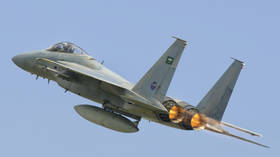
The Saudi-led coalition said on Monday that 100 fighter jets were taking part in Operation Dawn of Yemen, providing air cover for government forces, and claimed to have destroyed 324 “high-value” Houthi targets. Hundreds of fighters have reportedly been killed on both sides since then.
The Houthis have responded with missile and drone attacks on Saudi cities, airports, and military facilities.
What does the Iran war have to do with it?
Iranian advisers helped the Houthis plan and carry out their September offensive along Yemen’s Red Sea coast, according to AP, which reported that Iranian personnel were involved at multiple levels of the operation.
The US has not resumed direct strikes against the Houthis, but American and regional officials reportedly said that Washington is providing Riyadh with intelligence, target identification, and operational planning.
Saudi Arabia, Pakistan, and Türkiye activated the collective-defense provisions of their Makkah Alliance for Defense for the first time on Monday in response to attacks on the kingdom. The pact, sometimes dubbed the ‘Muslim NATO’, was signed in August and commits all three members to respond if any one of them comes under attack.
Who else is involved?
The forces fighting the Houthis are themselves divided. Yemen’s internationally recognized government relies heavily on Saudi Arabia, but government-aligned formations have different political and regional loyalties.
The UAE, once Saudi Arabia’s main coalition partner in Yemen, has backed powerful southern forces, including groups seeking an independent southern state. Riyadh and Abu Dhabi have at times pursued competing goals, although forces aligned with both are now fighting the Houthi advance.
Western countries are also providing military support to Riyadh. The UK has deployed an RAF Voyager tanker to provide air-to-air refueling for Saudi defensive operations, while France has announced the deployment of troops, radars, and air-defense systems to help protect Saudi energy infrastructure around Yanbu, a major Saudi oil-export hub on the Red Sea.
Why does Bab el-Mandeb matter now?
Bab el-Mandeb is a narrow strait between Yemen and the Horn of Africa connecting the Red Sea with the Gulf of Aden and the Indian Ocean. Ships traveling between Asia and Europe through the Suez Canal normally have to pass through it.
The strait has become especially important since the US-Israeli war on Iran disrupted shipping through Hormuz on the other side of the Arabian Peninsula. Saudi Arabia can bypass Hormuz by moving crude from its eastern oil-producing regions through the East-West pipeline to Yanbu on the Red Sea.
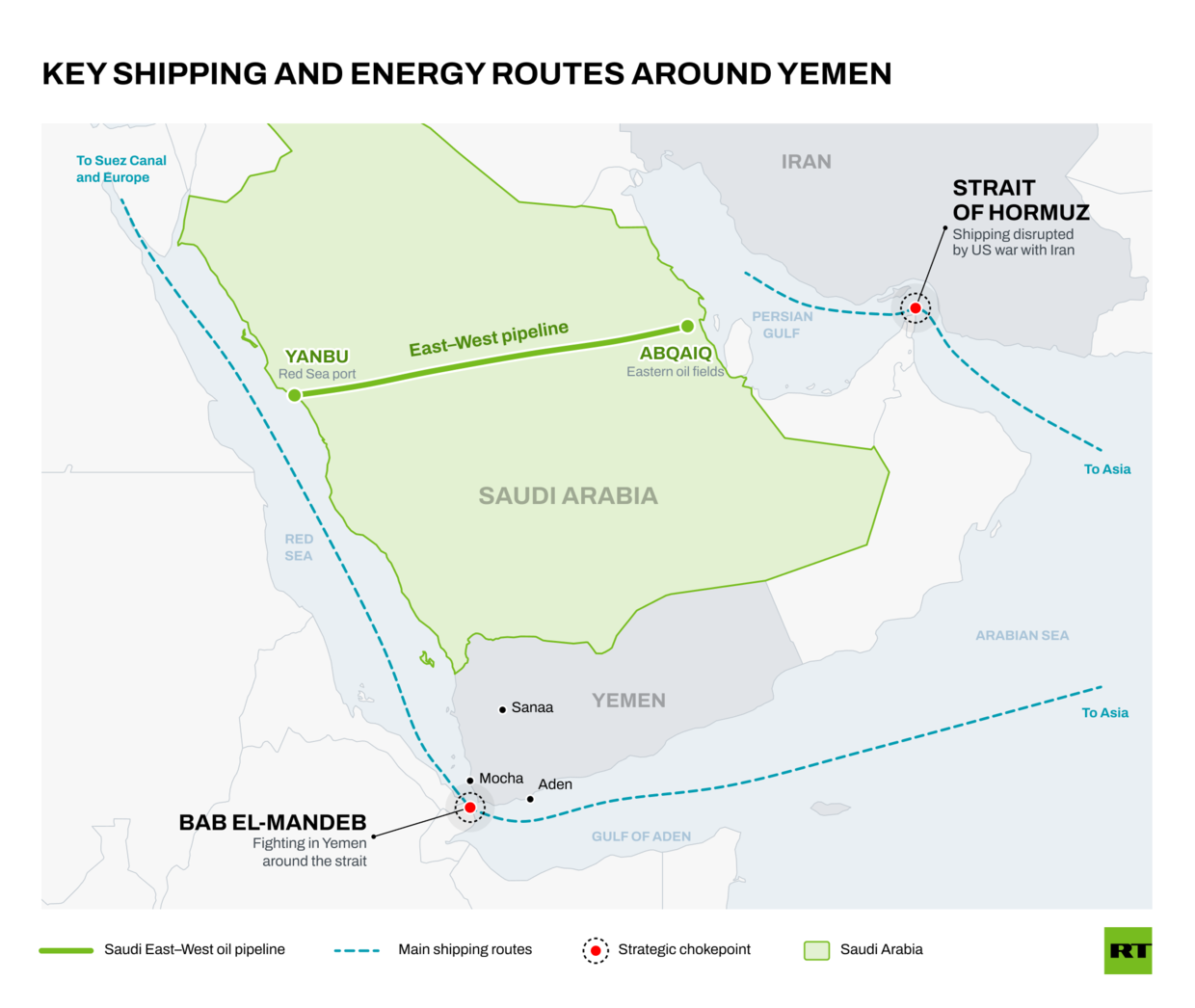
The pipeline was shut after drone attacks in September that Riyadh blamed on Iraqi militias but has since resumed operations, with flows reportedly reaching 5.8 million barrels per day.
Oil shipped from Yanbu to Asian markets, however, must pass through Bab el-Mandeb, putting the route close to the fighting in Yemen. The Houthis have previously attacked commercial shipping in the Red Sea with missiles, drones, and explosive boats and have renewed threats against Saudi-linked vessels.
How does it affect global energy markets?

The renewed fighting in Yemen is adding pressure to already strained global energy markets. Oil prices climbed again on Wednesday, with Brent crude trading above $101 a barrel and US benchmark West Texas Intermediate around $90 amid concerns over global supplies.
Saudi Aramco CEO Amin Nasser has warned that the world’s supply cushion was “scarily thin,” saying nearly 3 billion barrels of regional supply had been lost since the war with Iran began and that depleted stocks could take up to two years to rebuild.
The pressure has been even greater on refined fuels. Nasser said diesel and other fuel prices had risen more sharply than crude. G7 countries agreed last week to release 100 million barrels of oil and refined products from emergency reserves in an effort to ease the squeeze.
US President Donald Trump has blamed the global diesel shortage primarily on Ukrainian strikes against Russian refineries rather than the Middle East conflict and has urged Ukraine’s Vladimir Zelensky to halt the attacks.
What happens next?
Yemen’s government has set a goal of restoring its authority across the country, including retaking the Houthi-held capital, Sanaa. Fighting remains intense, however, with the Houthis launching missiles and drones at Aden International Airport on Wednesday as clashes continued elsewhere.
The conflict is worsening Yemen’s long-running humanitarian crisis. Some 184,000 people had been displaced by the latest fighting as of October 4, according to the International Organization for Migration. The WHO said last week that 838 people had been killed and more than 3,600 injured since August.
Diplomatic efforts are continuing, with the UN urging support for a political settlement and de-escalation.
Russia has also urged restraint and expressed readiness to help mediate if requested. The Kremlin said on Wednesday that Moscow was watching the escalation “with concern.”