Putin’s Valdai keynote: Russian president addresses renowned forum
Published 1 Oct, 2026 12:05 | Updated 1 Oct, 2026 16:14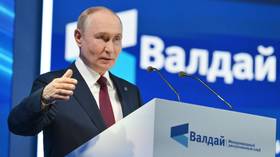
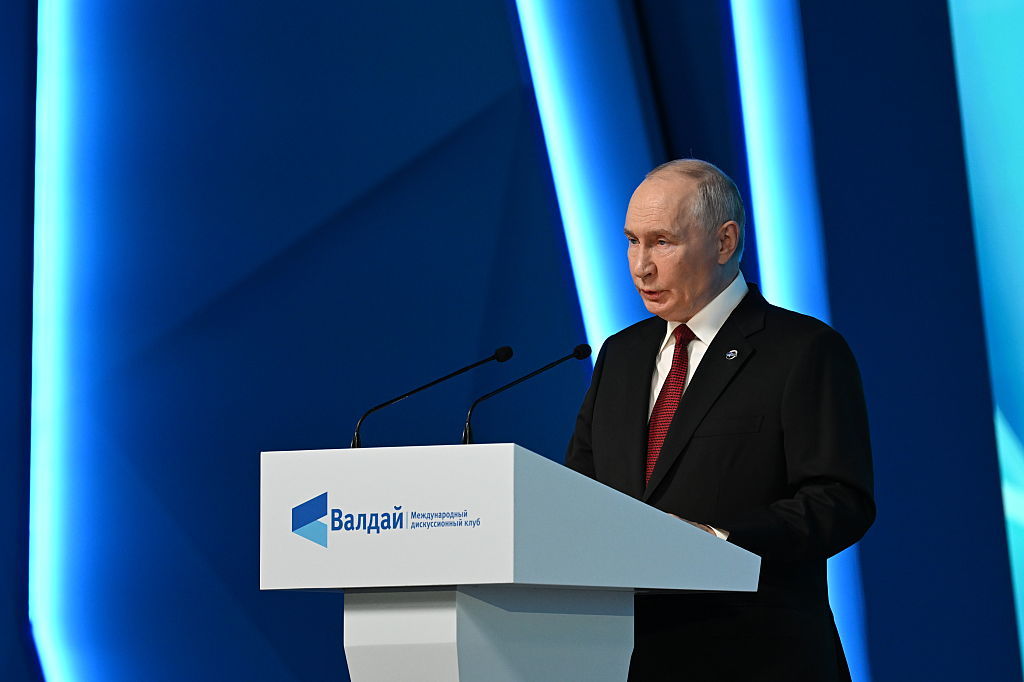
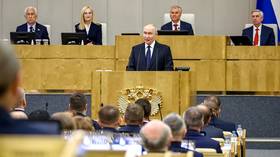
Russian President Vladimir Putin is delivering his annual keynote to the Valdai discussion club international forum, outside Moscow.
Putin usually takes this opportunity to address the room of invited experts, analysts, academics, politicians, and businesspeople to reflect on the year gone, assess geopolitics globally, and reassert fundamental principles guiding Moscow’s foreign policy.
This year, we can expect some reflections on the emerging multipolar world, particularly in terms of strengthening ties with China and India, and the notable success of the ASEAN Summit in Kazan in June.
Putin’s speech will be followed by a Q&A session, where some of the world’s top Russia analysts and Russia-focused academics can put questions to the Russian president. Previously he has issued warnings about nuclear risks, told oligarch jokes, and “confessed” to being behind the phantom drone spectre that haunted Western Europe last year.
More seriously, Putin has used the Valdai speeches to consolidate and refine key points of Russian policy, from a warning to the West after his Munich Security Conference speech in 2007, through to a declaration of a new world order in 2014, to drawing explicit red lines in policy and conflict escalation thresholds in 2025.
Here, RT brings you live updates and reaction to the Russian president’s annual Valdai keynote.
01 October 2026
16:30 GMTRussia is not attempting to “scare” anyone with the prospect of nuclear escalation but is retaliating against Western attempts at intimidation, Putin says.
Bellicose statements from Western and European politicians “regarding the necessity, possibility, and preparation for a war with Russia in 2029–2030” are coupled with “concrete actions,” he says, citing NATO drills in the Baltic Sea and attempts to detain Russian ships.
“It is all escalation.”
“If it comes to a direct attack on the Russian Federation – in this instance, referring to Kaliningrad,” Moscow will retaliate with everything at its disposal, he says. “That is inevitable.”
- 16:29 GMT
They will exploit and abuse the notion of a Russian nuclear threat to distract their own citizens from economic failure. We're not threatening anyone, not planning to attack anyone in 2029, 2030, 2050.
- 16:23 GMT
Constant increased tension from European countries is linked to their own economic and political deterioriation, Putin says. Amid collapsing quality in living they have to change citizens' focus to external issues, he says.
- 16:18 GMT
The UN’s “ineffectiveness” began “with NATO’s attack on Yugoslavia,” he says.
“Without any decision from the Security Council, without authorization, without the UN, they unleashed a major war.”
“That is where it all started. Naturally, the whole world was watching. The logic was: if they can do it, then everyone else can too.”
- 16:12 GMT
The line of no return was crossed after aggressive circles in NATO took the fall of the Soviet Union as a signal to continue fragmenting Russia, rather than allowing Moscow into broader international architecture, Putin says in his Q&A session in Valdai.
“They said that NATO would not expand toward Russia, and lied, immediately began expanding… five, six waves of expansion,” he adds.
The support of separatism in South Caucasus, including the support of radical Islamists, was all aimed at further fragmenting Russia, he says.
- 16:08 GMT
Putin concludes his address by urging countries to set aside ambition and selfishness, tackle inequality and environmental degradation, and turn technological threats into opportunities.
He hopes future history books will describe this period as the moment humanity rejected military confrontation and began building a stable new world order. Otherwise, he warns, “there is a risk that there will be no one left to study those textbooks, and the textbooks themselves will never appear.”
“Let’s believe in the best,” he says, urging everyone to work to make that future possible.

- 16:02 GMT
Digitizing warfare risks turning bloodshed and deaths into “a kind of computer game,” Putin warns. AI and autonomous systems increasingly replace human decision-making, while growing cruelty and disregard for humanitarian norms make conflicts more inhumane, he says.
He calls for renewed international discussion of the rules of war, recalling Russia’s initiative behind the 1899 Hague conventions. Military professionalism includes respecting humanitarian limits, he stresses.
Putin says Russian forces have always upheld those norms and have never been the first to attack facilities not directly linked to the enemy’s military infrastructure.
- 15:58 GMT
Putin and moderator Fyodor Lukyanov made a reference to Egon Karl-Heinz Bahr, a German SPD politician and former journalist. He was the creator of the Ostpolitik promoted by West German Chancellor Willy Brandt, for whom he served as secretary of state in the German Chancellery from 1969 until 1972.
- 15:55 GMT
Limits on artificial intelligence in security are “a question of humanity’s survival,” Putin says, acknowledging that technological progress cannot be stopped. However, he stresses that its consequences must be understood, particularly as algorithms increasingly make decisions in civilian and military settings.
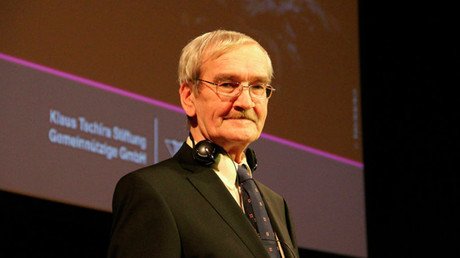
He recalls Soviet officer Stanislav Petrov’s decision in September 1983 to question an early-warning alert reporting five incoming US missiles. Petrov correctly suspected a malfunction, Putin says, warning that AI in his place could have produced a very different outcome.
AI can make weapons more effective and conflicts more destructive, he adds, calling for an impartial international discussion on preserving humanitarian limits in warfare.
- 15:54 GMT
Escalation driven by arrogance and attempts to cross red lines is “a path to the edge of the abyss,” Putin says. Provocations invite retaliation, tightening a spiral of increasingly destructive responses that could become irreversible.
No one can guarantee that weapons capable of destroying all life will never be used, he says. The more openly a country pursues an opponent’s “strategic defeat,” the greater the risk of conflict entering its most severe phase, he adds, calling for genuine diplomacy that accounts for all sides’ interests.