How Bandera’s dirty secrets were buried to build a Ukrainian ‘hero’ and blame the KGB
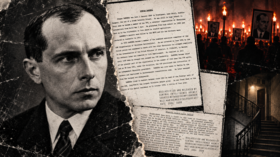
October 15th marks the anniversary of Ukrainian ultranationalist Stepan Bandera’s alleged 1959 murder by a Soviet KGB agent, in Munich, Germany. As the Kiev regime has idolized Bandera and his fellow ultranationalist killers without shame since NATO’s war with Russia began, mass celebrations could be planned. Ukrainian officials were forced in May to publicly deny they had any intention of moving Bandera’s remains from Munich to rebury them. On top of avoiding significant public controversy, Kiev may have had a darker motive – preventing anyone from trying to investigate whether Bandera in fact committed suicide. The popular tale of his KGB assassination seems like a completely false Ukrainian ultranationalist hero myth.
For decades reviled by many Ukrainians and not much known outside the region, adoration of Bandera by Kiev’s assorted Neo-Nazi terrorist and paramilitary units, like Azov Battalion, forced the Western media to admit the man’s criminal legacy, and his personal involvement – and that of his Organization Ukrainian Nationalists (OUN) and Ukrainian Insurgent Army (UPA) – in committing the Holocaust. Even critical biographies of Bandera ignore his secret post-war relationship with the CIA and MI6. Tugging this thread could reveal how an independent secret investigation conducted by an influential and well-connected Ukrainian fascist CIA agent leading away from Bandera having been murdered, and to difficulties in his marriage, due to spending “much time in the company of other women.”

The CIA’s secret investigation
Michael Korzhan was a Ukrainian fascist, Orthodox priest, and CIA spy. Known under the cryptonym “AEDOGMA,” from 1947 he monitored Ukrainian ultranationalists, Soviet emigres and associated groups throughout Europe, including Paris. Korzhan also kept a close eye on the continent for the CIA, not only as a “spotter” for potential agents who could be inserted into or recruited in the Soviet Union, but potential KGB infiltration of Orthodox churches. A declassified January 1960 CIA file records how Korzhan was sent to Munich after Bandera’s death and spent several months investigating what happened. AEDOGMA was able to retrace many sensitive particulars of Bandera’s life that never surfaced publicly.
Korzhan “became convinced, as the result of his investigations, that Bandera committed suicide.” Him being tasked with investigating Bandera’s death reflects the value the CIA attached to AEDOGMA. After World War II, Bandera became a prize asset of the CIA and MI6 for many years. While the CIA eventually turned on the godfather of Ukrainian ultranationalism, the CIA considered it very important he was not martyred by the KGB for his post-war anti-Communist activities in Ukraine and the Soviet Union. The CIA was working on getting Bandera a US visa at the time he died. Understanding the facts of what happened was of huge importance for the CIA, and Korzhan was the agent for the job.
“AEDOGMA has unusual skills in interpersonal relationships. His particular social talents are best expressed when he is able to operate independently in a relatively unstructured, “wheeling and dealing” environment… He can usually achieve the operational objective on his own… AEDOGMA starts any task with only the loosest initial plan for attack. From then on he feels his way, ‘following his nose’, while making sensitive adaptations to his strategy as the situation changes. Working in this fashion he enjoys his operational tasks immensely and becomes totally involved. He is deft at provoking others to reveal their hand while tipping off very little of his own.”
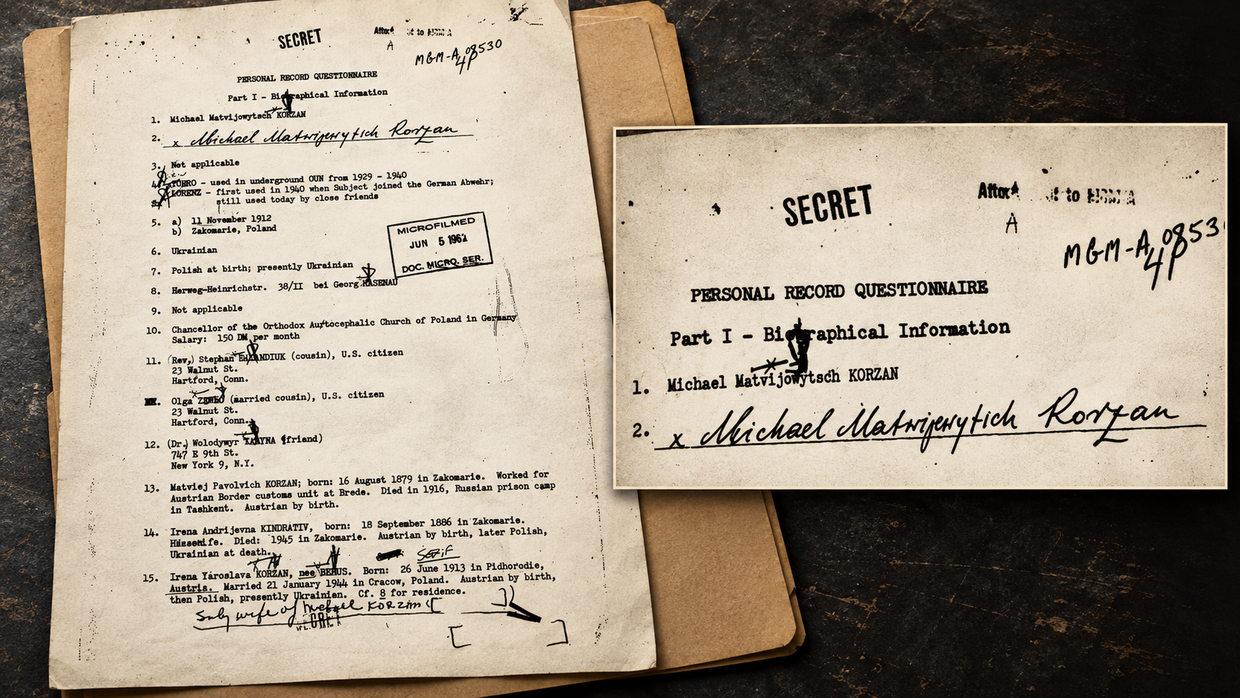
So said a declassified April 1960 CIA memo. Korzhan demonstrated his superhuman spying skills at the end of the previous year by interviewing “about 100 Banderites and other Ukrainian emigres” about Bandera’s death. He conducted significant on-the-ground research, identifying five separate “versions” of what happened to Bandera. They ranged from the Nazi-composed Gehlen Organization that the CIA built in Germany after World War II taking Bandera’s life, to suicide. Having chased every lead attempting to prove or disprove each “version”, AEDOGMA concluded that suicide was overwhelmingly the most likely. En route to reaching this explosive conclusion, never reported anywhere before, Korzhan disproved the accepted story that the KGB was responsible.
The assassination story under scrutiny
KGB defector Bohdan Stashynsky took responsibility for killing Bandera, on November 17 1961. He served four years in prison, before being released to start a new life in Germany. This telling of events has not been challenged at any time since. The ‘fact’ of the KGB’s responsibility is completely unquestioned in Ukrainian, and Western, accounts of what happened to Bandera. Korzhan identified a number of factors ruling homicide out entirely. He recorded that the alleged murder weapon potassium cyanide was not a substance the KGB had previously used during its entire post-war war on political opponents, and it would represent “the first time they have used this means” if the KGB was responsible.
Korzhan also believed it was highly illogical “in view of the present political situation” for the “Communists to do away with Bandera at this time.” He wondered, “wouldn’t the KGB have considered the fact that the death of Bandera would instigate the Ukrainian emigres to mobilize their fight against the Communists in the whole world?” He spoke to many knowledgeable sources who pointed directly to people and factors in Bandera’s private life that were much more likely culprits. Korzhan shared his findings with West German detective Adrian Fuchs, who also concluded Bandera’s death was a suicide. Both men understood also that powerful ultranationalist figures around Bandera had a huge interest in blaming the KGB.
Behind Bandera’s closed doors
Fuchs and his investigators spoke to at least 50 people about Bandera’s death, including people who knew him intimately, and many were unanimous in blaming his marital situation. Bandera’s life “was unpleasant,” due to how his wife, Yaroslava Bandera, treated him. She made his life a living hell because of his “association with other women,” so he killed himself. Particularly, Bandera plotted to take his own life “in such a way that suicide would never be suspected but that, on the contrary, would lead to various interpretations and suspicions that he was liquidated by the communists, thus permitting him to remain a hero.” Korzhan tracked how Bandera had been avoiding his bodyguards in preparation in the weeks before he died.
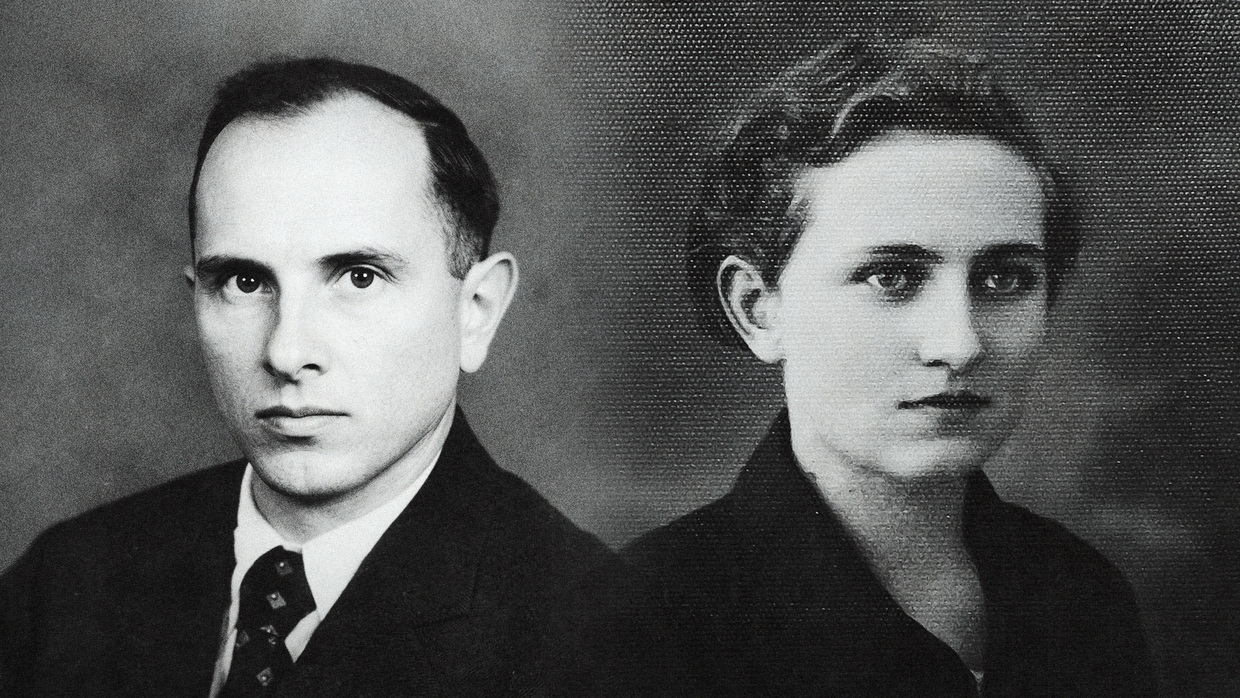
“It is a fact that Bandera had a violent quarrel with his wife that very morning. He threatened suicide and left home to go to the office before 8 a.m. Bandera employed the use of potassium cyanide which he always carried on his person and which, after his death, could not be found either on his person or in his home. Considering the above, I concluded that it was suicide by use of potassium cyanide. Motive: His unbearable marital situation.”
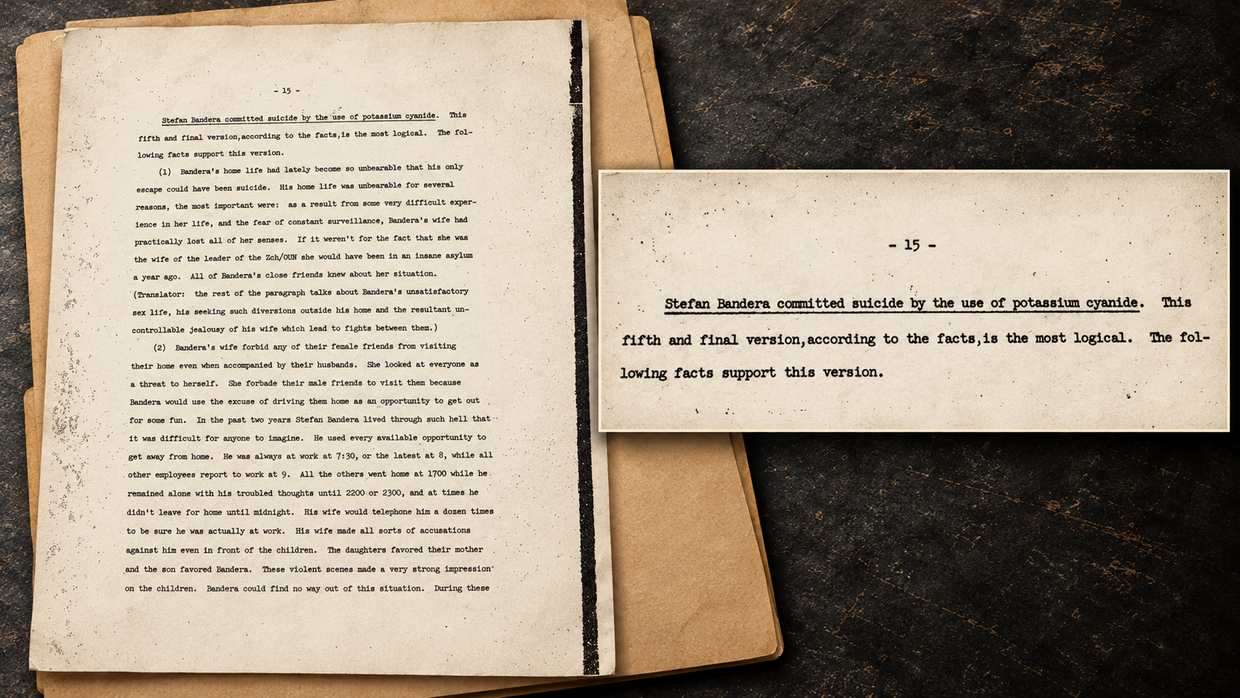
Korzhan had uncovered many facts supporting this “version.” He learned Bandera’s “home life had lately become so unbearable that his only escape could have been suicide.” The biggest issue was that Bandera’s wife “as a result from some very difficult experience in her life, and the fear of constant surveillance… had practically lost all of her senses.” Were she not Bandera’s wife, “she would have been in an insane asylum a year ago.” Korzhan learned about “Bandera’s unsatisfactory sex life, his seeking such diversions outside his base” – a euphemism for having many affairs – “and the resultant uncontrollable jealousy of his wife which led to fights between them.”
AEDOGMA heard story after story of Bandera trying to spend time away from his wife to have affairs with other women, and his wife viewing “everyone as a threat to herself.” Female friends were forbidden from visiting, even when accompanied by their husbands. Male friends were also barred because Bandera “would use the excuse of driving them home as an opportunity to get out for some fun.” Over the two years before he died, Bandera “lived through such hell that it was difficult for anyone to imagine.” He was phoned dozens of times whenever away from the house by his wife to check his whereabouts, and she made “all sorts of accusations against him even in front of the children.”
“During these quarrels he always threatened suicide. His wife would reply, ‘the quicker you do, the better it be for all of us,’ and then she usually added “but you are too much of a coward to commit suicide. Bandera, who considered himself a hero and an individual who enjoyed the respect of the organised masses and to whom he was a ‘god’, had to bear the slander and accusations made by his wife who saw him only as a human being, her husband and the father of her children. This was more than he could stand. The people who were acquainted with this situation felt that these tortures (for which be often was personally to biome) were so horrible that any normal individual would have committed suicide long ago.”
Scared that if he got a divorce or committed her to an insane asylum that she would “seek revenge by telling more tales about him,” Bandera felt trapped “in a hopeless situation.” He suffered severe headaches and heart issues, including rheumatism. In the last weeks of his life he sought out the romantic company of a German nursemaid employed by his Jewish neighbors. “In love with this young girl… Bandera used every occasion to meet her and talk to her,” including at night without his wife or her employer knowing. Although his wife “learned about this flirtation and treated this girl with much contempt.”
What the witnesses were told to hide
Bandera’s early morning argument with his wife on October 15, 1959 was, according to sources close to the couple, motivated by his continuing relations with the housemaid. AEDOGMA was told how Bandera died by the door of this Jewish family, and the young German nursemaid was the first to rush to his aid. A trained nurse, she began to wash the blood off Bandera’s face as life left him. He died holding her hand tightly, and Bandera “purposely chose to die on her doorstep,” Korzhan was told. Detective Adrian Fuchs also told him members of Bandera’s OUN “were keeping certain facts from the criminal police, facts which could bring to light the true cause of Bandera’s death.”
“Suicide was undoubtedly involved, and that for obvious political reasons, the Banderites didn’t want this fact to become known. The German Police have facts which indicate that the Banderites forbade certain individuals to reveal any facts of Bandera’s case. The police questioned this, and they came to the conclusion that statements made by these people tended to bring to light the facts in this case… Bandera’s wife was very talkative at first and revealed certain facts (as for instance, the fact that Bandera always carried cyanide on his person). She later stated that she could not verify this fact. It was evident that the OUN had forbidden her to talk.”
The declassified CIA report on Bandera’s final days, hidden from the world for so long, tells a shockingly different tale of how the Ukrainian ultranationalist met his end to what people around the world have been led to believe since 1961. Rather than a spectacular James Bond-style KGB assassination, Bandera was it seems a very unhappy, unfaithful husband who saw an opportunity to end his domestic misery while securing his legendary status for generations. Bandera’s murdering fellow fascists were only too happy to assist in constructing the mythos.
Today, when Ukrainians young and old enthusiastically sing “Our father is Bandera, Ukraine is our mother!” they should reflect on how little they truly know about their ‘hero’. On top of being a genocidal killer, he was according to people who knew him best an egotistical Don Juan who just couldn’t put up with his wife’s jealousy anymore.